
Foam board RC planes offer an accessible entry point into the captivating world of radio-controlled aviation, with readily available foam board RC plane plans (PDF) online.
What are Foam Board RC Planes?
Foam board RC planes are miniature aircraft constructed primarily from foam board, a lightweight and inexpensive material. These planes are controlled remotely using a radio transmitter and receiver, allowing enthusiasts to experience the thrill of flight. A key aspect of building these planes is utilizing readily available foam board RC plane plans (PDF), downloadable from various online resources.
These plans provide detailed instructions and templates for cutting and assembling the foam board components. The simplicity of foam board construction makes them ideal for beginners, offering a relatively quick and affordable path to building and flying your own RC aircraft. Many designs cater to different skill levels, from simple trainers to more complex sport and scale models.
Why Choose Foam Board for RC Planes?
Foam board presents several advantages for RC plane construction. Its lightweight nature contributes to excellent flight characteristics, while its affordability makes it accessible to hobbyists of all budgets. Crucially, numerous foam board RC plane plans (PDF) are freely available, lowering the barrier to entry.
The material is also easy to cut and shape using simple tools like hobby knives, facilitating customization and repairs. Furthermore, foam board’s impact resistance offers a degree of durability, especially important for beginner pilots prone to crashes. Utilizing downloadable plans ensures accurate construction and predictable flight performance, making it a fantastic learning platform.

Finding Foam Board RC Plane Plans (PDF)
Foam board RC plane plans (PDF) are abundant online, ranging from simple trainers to complex scale models, accessible through various websites and communities.
Popular Online Resources for Free Plans
Numerous websites cater to RC enthusiasts seeking foam board RC plane plans (PDF) at no cost. Paper-Replika.com offers designs, including RC planes from fast food boxes, showcasing creative builds. Online forums and communities dedicated to RC aviation frequently share plans created by members, fostering collaboration and innovation.

Websites like FliteZone and RC Groups often host dedicated sections for free foam board plans, categorized by skill level and aircraft type. A simple web search using keywords like “free foam board RC plane plans PDF” will reveal a wealth of options. Remember to carefully review plans before building, ensuring clarity and completeness for a successful project. Always prioritize safety and build within your skill level.
Paid Plan Providers: What You Get
While many foam board RC plane plans (PDF) are freely available, purchasing plans from dedicated providers often unlocks significant benefits. These typically include more detailed and professionally drafted plans, often with step-by-step illustrated instructions, enhancing the building experience.
Paid plans frequently feature optimized designs for improved flight performance and durability, alongside material lists and build tips. Some providers offer support forums or direct assistance, valuable for beginners. Expect higher-quality plans with precise measurements and potentially included templates for cutting parts accurately. Investing in paid plans can save time and frustration, leading to a more rewarding build.
Understanding Plan Symbols and Terminology
Successfully utilizing foam board RC plane plans (PDF) requires deciphering common symbols and terminology. Plans often employ lines to indicate fold lines, cut lines, and glue surfaces. Symbols denote hardware placement – motors, servos, and linkages – crucial for correct assembly.
Familiarize yourself with terms like “span” (wing width), “chord” (wing depth), “dihedral” (upward wing angle), and “incidence” (angle of the wing relative to the fuselage). Understanding these concepts ensures accurate construction. Many plans include a key explaining all symbols used, so always refer to it before beginning your build for a smoother process.

Essential Materials and Tools
Foam board RC plane plans (PDF) guide construction, but you’ll need specific materials – foam board, adhesives, cutting tools, and electronics – to bring your design to life.
Types of Foam Board for RC Planes
Foam board RC plane plans (PDF) often don’t specify which foam board, leaving builders with choices. Standard polystyrene foam board is economical and easy to find, suitable for initial builds following simpler plans.
Depron foam is lighter and stronger, ideal for more complex designs or when weight is critical, though it’s pricier. Fanfold foam, a corrugated variety, offers good strength-to-weight ratio and is often used with carbon fiber spars for reinforcement, as some plans suggest.
Consider the plan’s complexity and your skill level when selecting foam; heavier planes are more durable, while lighter ones offer better flight performance.
Adhesives: Choosing the Right Glue
Successfully building from foam board RC plane plans (PDF) hinges on selecting the correct adhesive. Standard white glue is affordable and works well for initial tacking, but requires longer drying times. Hot glue provides a fast bond, crucial for quick assembly, but adds weight and can melt the foam if applied excessively.
Foam-safe CA (cyanoacrylate) glue offers a strong, fast bond, but requires careful application to avoid damaging the foam.
Urethane glue is another option, providing a strong, flexible bond, but it expands during curing, so use sparingly.
Cutting Tools: Knives, Blades, and Hot Wires
Precise cutting is paramount when working with foam board RC plane plans (PDF). A sharp hobby knife with replaceable blades is essential for clean, accurate cuts. Different blade shapes – straight, curved, and pointed – offer versatility for various plan features.
A metal ruler or straight edge guides the knife for straight lines. For complex curves, consider a flexible metal ruler. Hot wire cutters provide exceptionally clean cuts, especially for thicker foam, but require practice and a controlled environment.
Always use a fresh blade for optimal results and safety!
Electronics: Motors, ESCs, Servos, and Receivers
Bringing your foam board RC plane plans (PDF) to life requires careful electronics selection. Brushless motors offer superior power and efficiency compared to brushed motors, crucial for flight performance. An Electronic Speed Controller (ESC) regulates power to the motor, responding to signals from the receiver.
Servos control the control surfaces – ailerons, elevator, and rudder – translating receiver signals into movement. A receiver decodes signals from your transmitter, relaying instructions to the ESC and servos.
Ensure compatibility between components!

Building Your First Foam Board RC Plane
Foam board RC plane plans (PDF) provide a blueprint for construction; meticulous assembly, following the plans, is key to a successful and enjoyable build experience.
Step-by-Step Construction Guide (General)
Utilizing foam board RC plane plans (PDF) begins with carefully printing and reviewing the entire document before commencing construction. Start by cutting out all necessary foam board pieces, precisely following the dimensions outlined in the plans.
Next, assemble the fuselage, ensuring proper alignment and secure bonding with appropriate adhesive. Wing construction typically involves creating ribs and spars for strength, then covering them with foam board.
The tail section – horizontal and vertical stabilizers – requires similar precision. Reinforce critical areas with tape or carbon fiber for durability. Finally, install control surfaces, ensuring free movement, and prepare for electronics integration, always referencing the foam board RC plane plans (PDF).
Wing Construction Techniques
Wing construction, guided by foam board RC plane plans (PDF), often starts with cutting foam board ribs to the specified airfoil shape. These ribs provide the wing’s aerodynamic profile. Spars, typically carbon fiber or wood, are then inserted to add strength and prevent flexing during flight.
Adhesive is applied carefully to join the ribs to the spars and the top and bottom foam board sheeting. Ensuring a smooth, consistent bond is crucial for performance.
Some plans utilize a flat-bottomed airfoil for simplicity, while others feature more complex shapes. Precise alignment, as shown in the foam board RC plane plans (PDF), is vital for stable flight.
Fuselage Assembly and Reinforcement
Fuselage assembly, detailed in foam board RC plane plans (PDF), typically involves scoring and folding foam board pieces to create the body’s shape. Accurate cuts and folds are essential for a symmetrical and strong structure. Internal formers, also cut from foam board, provide additional support and maintain the fuselage’s form.
Reinforcement is critical; carbon fiber strips or wooden spars are often glued along the length of the fuselage to resist bending and twisting forces during flight.
Pay close attention to the plans (PDF) for locating the motor mount and battery compartment.
Tail Section Construction and Alignment
Tail section construction, guided by foam board RC plane plans (PDF), usually involves building the horizontal and vertical stabilizers separately. These are often created from multiple layers of foam board, glued together for increased rigidity. Precise cutting is vital for symmetrical control surfaces – the elevator and rudder.
Alignment is paramount; the tail section must be perfectly perpendicular to the fuselage to ensure stable flight.
Refer to the plans (PDF) for correct angles and ensure secure attachment using epoxy or strong foam-safe adhesive.
RC Plane Designs & Popular Models
Foam board RC plane plans (PDF) unlock diverse designs, from beginner-friendly trainers to agile sport planes and efficient gliders, catering to all skill levels.
Trainer Planes: Ideal for Beginners
Trainer planes, often featured in readily available foam board RC plane plans (PDF), are specifically designed for novice pilots. These models prioritize stability and forgiving flight characteristics, making learning to fly significantly easier. Look for plans emphasizing high-wing configurations and gentle airfoil designs.
The Lazy Bee, a popular choice, frequently appears as a free plan download. These designs typically utilize simple construction techniques, minimizing complexity for first-time builders. Successful first flights build confidence, and a well-chosen trainer, built from a reliable PDF plan, is the cornerstone of a rewarding RC aviation journey. Expect slower speeds and predictable responses, crucial for mastering basic control.
Sport Planes: For Intermediate Pilots
Sport planes, accessible through numerous foam board RC plane plans (PDF), represent a step up in complexity and performance from trainer aircraft. These models offer increased speed, agility, and maneuverability, challenging pilots to refine their skills. Plans often feature lower-wing designs and more aggressive airfoil shapes.
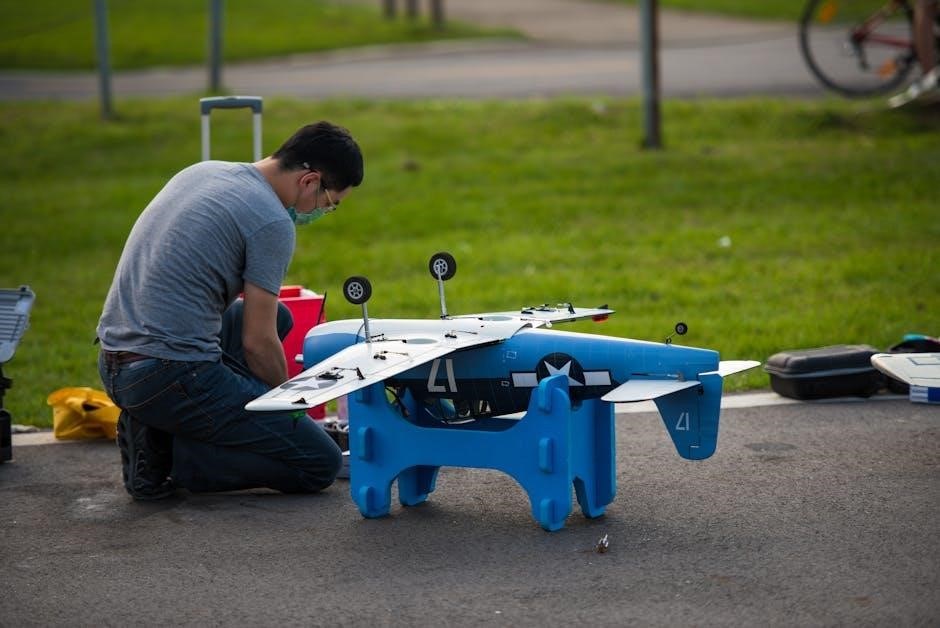
Expect more intricate build processes and a greater emphasis on precise control surface setup. Many plans incorporate features like ailerons for roll control, enabling advanced aerobatic maneuvers. The Boeing model, constructed from fast food box foam, exemplifies this category. Successfully building and flying a sport plane demonstrates a solid grasp of RC fundamentals and opens doors to more dynamic flight experiences.
Glider Plans: Simple and Efficient
Glider plans, frequently found as free foam board RC plane plans (PDF), provide an excellent introduction to aerodynamic principles without the complexity of powered flight. These designs rely on skillful launches and exploiting rising air currents – thermals – to stay aloft. Construction is typically straightforward, focusing on lightweight builds and efficient wing designs.

Many plans emphasize simplicity, utilizing minimal parts and easy-to-follow instructions. This makes them ideal for builders seeking a less demanding project. Gliders demand precise balancing and careful trimming for optimal performance. Mastering glider flight fosters a deeper understanding of lift, drag, and control, building a strong foundation for more advanced RC endeavors.
Scale Model Plans: Replicating Real Aircraft
Scale model plans, often available as detailed foam board RC plane plans (PDF), present a rewarding challenge for experienced builders. These plans meticulously recreate the appearance of iconic aircraft, demanding accuracy in shaping and detailing. While more complex than basic designs, the result is a visually stunning and historically significant flying model.
Successfully building a scale model requires patience and attention to detail. Plans often include intricate outlines, rib templates, and guidance on replicating specific features. Modifications for RC functionality – motor mounts, control surface linkages – must be integrated seamlessly. The satisfaction of seeing a miniature version of a legendary aircraft take to the skies is immense.

Preparing for Flight
Preparing for flight involves crucial steps like calculating the center of gravity and calibrating control surfaces, often guided by your foam board RC plane plans (PDF).
Center of Gravity (CG) Calculation and Adjustment
Determining the correct Center of Gravity (CG) is paramount for stable flight. Your foam board RC plane plans (PDF) will explicitly indicate the CG location, usually measured as a distance from the leading edge of the wing. To find it, balance the plane gently with your fingertips positioned at the specified point.
If the nose dips, add weight to the tail; if the tail drops, add weight to the nose. Small adjustments are key! Use clay, tape, or repositioning components like the battery. An improperly adjusted CG leads to instability, making the plane difficult or impossible to control; Always double-check the CG before each flight, ensuring a safe and enjoyable experience.
Control Surface Setup and Throw Calibration
Proper control surface setup is crucial for responsive handling. Your foam board RC plane plans (PDF) will detail the intended control surface deflections. Ensure linkages are free and secure, connecting servos to ailerons, elevator, and rudder correctly. “Throw” refers to the maximum deflection of these surfaces.
Begin with conservative throws – excessive throws can cause instability. Gradually increase them during test flights, observing the plane’s response. Use your transmitter’s dual-rate settings to adjust throws easily. Precise calibration ensures predictable control, allowing for smooth maneuvers and a safe, controlled flight experience.
Battery Selection and Installation
Selecting the right battery is vital for performance and flight time. Your foam board RC plane plans (PDF) will specify the recommended battery type (LiPo is common) and voltage. Consider the ‘C’ rating – higher C ratings deliver more current for powerful motors. Ensure the battery’s capacity (mAh) suits your desired flight duration.
Install the battery securely, following the plans’ guidance for proper placement to maintain the center of gravity. Use a battery strap for added safety. Always connect the battery after the transmitter to prevent unexpected motor activation.
Pre-Flight Checks: A Comprehensive List
Before each flight, a thorough check is crucial for safety and success. Refer to your foam board RC plane plans (PDF) for specific recommendations. Verify the control surfaces move correctly in the intended directions. Confirm the propeller is securely attached and undamaged. Inspect all wiring connections for looseness or damage.
Check the battery charge level and ensure it’s firmly secured. Perform a range test with the transmitter. Finally, visually inspect the entire airframe for any signs of damage or weakness before takeoff.

Troubleshooting Common Issues
Addressing problems is part of the hobby! Consult your foam board RC plane plans (PDF) and online resources for solutions to common flight challenges.
Stalling and Loss of Control
Stalling occurs when the wings lose lift, often due to excessive angle of attack or insufficient airspeed. Refer to your foam board RC plane plans (PDF) for recommended control surface deflections and airspeed ranges. Ensure the center of gravity (CG) is correctly positioned, as an incorrect CG significantly impacts stability.
Loss of control can stem from various factors, including radio interference or improper control surface setup. Double-check your transmitter and receiver connections. Review the plans for correct elevator, aileron, and rudder configurations. Practice smooth, coordinated maneuvers to maintain control, and always fly in an open area, away from obstructions.
Motor and ESC Problems
Motor issues can range from simple connection problems to complete failure. Consult your foam board RC plane plans (PDF) to verify the correct motor and Electronic Speed Controller (ESC) specifications. Ensure proper soldering and secure wiring connections. Overheating is a common issue; check for adequate airflow around the motor.
ESC malfunctions often manifest as erratic motor behavior or a complete lack of response. Confirm the ESC is correctly programmed for your motor and battery. Inspect the ESC for physical damage. Always use a battery with the correct voltage and capacity as outlined in the plans to prevent ESC overload and potential failure.
Radio Interference and Signal Loss
Radio interference can severely impact control, potentially leading to a crash. Review your foam board RC plane plans (PDF) for recommended receiver placement, away from carbon fiber or metal components which can cause signal blockage; Ensure your transmitter and receiver are on compatible frequencies and properly bound.
Signal loss can occur due to distance, obstructions, or interference from other electronic devices. Perform a range test before each flight, walking away from the plane while testing control response. Consider using a receiver with signal diversity for improved reliability. Always fly in open areas, avoiding power lines and crowded spaces.
Repairing Foam Board Damage
Inevitably, crashes happen! Your foam board RC plane plans (PDF) won’t prevent all impacts, so learning repair techniques is crucial. For minor tears, use foam-safe CA glue (cyanoacrylate) or packing tape. Reinforce repaired areas with strapping tape for added strength. Larger damage may require patching with new foam board, carefully cut to fit and glued in place.
Consider using hot glue sparingly for structural repairs, but avoid using it directly on sensitive electronics. Always ensure the glue is fully cured before flying. Refer to online resources and forums for specific repair tips related to your plane’s design.

Advanced Techniques
Foam board RC plane plans (PDF) can be enhanced with techniques like adding functional flaps, ailerons, and carbon fiber reinforcement for improved performance.
Adding Flaps and Ailerons
Utilizing foam board RC plane plans (PDF) as a base, incorporating flaps and ailerons significantly enhances control and maneuverability. Flaps, positioned on the trailing edge of the wing near the fuselage, increase lift at lower speeds, crucial for slower approaches and landings. Ailerons, located on the wingtips, control roll, enabling precise turns and coordinated flight.
Modifying plans to accommodate these features requires careful cutting and hinging. Reinforcing the control surfaces with lightweight materials like carbon fiber tape ensures durability and responsiveness. Proper linkage setup, using pushrods and servo horns, is vital for accurate control. Experimentation with different flap and aileron deflections allows pilots to tailor the flight characteristics to their preferences and flying style.
Reinforcing with Carbon Fiber
When working with foam board RC plane plans (PDF), carbon fiber reinforcement dramatically increases structural integrity and flight performance. Key areas benefiting from this include wing spars, leading edges, and fuselage sections prone to stress. Carbon fiber rods or strips, adhered with appropriate epoxy, resist bending and twisting forces during flight maneuvers.
Strategic placement minimizes weight gain while maximizing strength. Consider reinforcing high-load areas like wing roots and control surface hinges. Proper application involves careful alignment and sufficient curing time for the epoxy. This technique extends the lifespan of foam board models, enabling more aggressive flying and reducing the risk of in-flight failures.
Improving Aerodynamics
Utilizing foam board RC plane plans (PDF) is just the starting point; refining aerodynamics unlocks superior flight characteristics. Streamlining the fuselage by carefully shaping the nose and minimizing protrusions reduces drag. Wing airfoil selection, even with basic foam board, impacts lift and stall speed – research suitable profiles.
Adding features like winglets can reduce induced drag, enhancing efficiency. Smooth surfaces are crucial; carefully apply covering materials and minimize gaps. Precise control surface alignment and proper hinging contribute to predictable handling. Small adjustments, informed by flight testing, can yield significant improvements in stability and overall performance.